
This is the fastest gaming graphics card NVIDIA makes, and in Australia it’s also one of the hardest to buy at a sensible price. It has 32GB of video memory, a 575-watt appetite and enough power to run games at 4K with every setting turned up. It’s a remarkable piece of hardware. It’s also far more than most people need.
This guide covers what the GeForce RTX 5090 actually is, what it costs in Australia right now, how it compares with the RTX 5080 and the old RTX 4090, what you need to run one properly, and who should and shouldn’t buy it. We sell complete RTX 5090 PCs, but we’ll be just as clear about when a cheaper card makes more sense.
Quick answer
The RTX 5090 is NVIDIA’s flagship GeForce card, with 21,760 CUDA cores and 32GB of GDDR7 memory. It launched in Australia at $4,039 in January 2025, but local prices have climbed well above that during the 2026 memory shortage. It suits 4K high-refresh gaming, 3D rendering and local AI. For most gamers, an RTX 5080 is the smarter buy.
In this guide
What is the RTX 5090?
The NVIDIA RTX 5090 is the top card in the GeForce RTX 50 series, built on NVIDIA’s Blackwell architecture. It launched on 30 January 2025 alongside the RTX 5080, and it replaced the RTX 4090 as the fastest consumer graphics card you can buy.
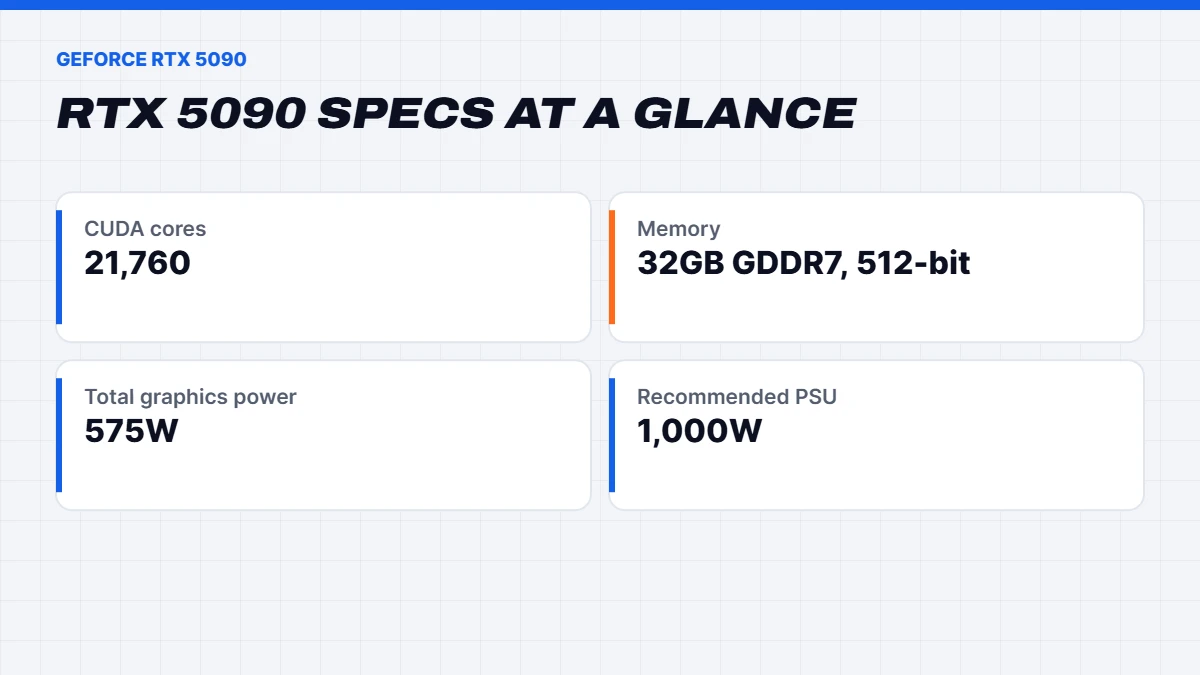
Three things set it apart from everything else in the range. First, sheer size: 21,760 CUDA cores, about twice as many as the RTX 5080. Second, memory: 32GB of fast GDDR7 on a 512-bit bus, which matters enormously for 3D rendering, video work and running AI models locally. Third, features: like the rest of the RTX 50 series, it supports DLSS 4 with Multi Frame Generation, which uses AI to generate extra frames and push frame rates far higher than the card could render on its own.
RTX 5090 specs
Here are the official numbers from NVIDIA’s RTX 5090 page:
| Spec | GeForce RTX 5090 |
|---|---|
| Architecture | Blackwell |
| CUDA cores | 21,760 |
| Memory | 32GB GDDR7 |
| Memory interface | 512-bit |
| Boost clock | 2.41GHz |
| AI TOPS | 3,352 |
| Total graphics power | 575W |
| Recommended system power | 1,000W |
| Power connector | One 16-pin (12V-2×6) cable or 4 x 8-pin with adapter |
| Display outputs | 3 x DisplayPort, 1 x HDMI |
Partner cards from ASUS, MSI, Gigabyte and others use the same chip with their own coolers and factory overclocks, so clocks and sizes vary a little. Some are enormous, so check the length and thickness against your case before you buy.
RTX 5090 price in Australia
The RTX 5090 price at launch in Australia was $4,039 for NVIDIA’s Founders Edition design, compared with US$1,999 in the United States. Partner cards were priced higher from the start, and supply was tight from day one.
2026 has made things harder. A global shortage of memory chips, driven by AI data centres, has pushed graphics card prices up across the board, and NVIDIA’s flagship, with its 32GB of memory, has been hit hardest. Through 2026, local retail prices have sat well above the launch figure, often thousands of dollars higher, with stock coming and going. In short, the RTX 5090 price Australia buyers see depends heavily on stock on the day. If you’re tracking it, expect it to move week to week, and be wary of grey imports without a local warranty.
This is one area where a complete PC can make sense even for people who’d normally build their own. A prebuilt system with this card is priced as a whole, comes with a power supply matched to the card and is covered by one warranty, which is worth a lot on a part this expensive.
How fast is the RTX 5090?
We don’t quote frame rates we haven’t measured ourselves, because they change with every driver, game patch and settings tweak. What’s well established from launch reviews is the overall picture. The GeForce RTX 5090 is roughly a quarter to a third faster than the RTX 4090 at 4K in traditional rendering, and the gap over the RTX 5080 is the biggest between any two cards in the range.
The gap shrinks at lower resolutions. At 1080p and often at 1440p, even a fast processor struggles to feed the card quickly enough, so you’re paying for performance you can’t fully use. At 4K, with ray tracing and path tracing turned on, it stretches its legs, and with DLSS 4 Multi Frame Generation it can drive 4K screens at very high refresh rates.
For creative work, the card’s 32GB of memory is often the bigger story than raw speed. Large 3D scenes, 8K video timelines and AI models that simply won’t fit on a 16GB card run comfortably here.
DLSS 4 and Multi Frame Generation
DLSS 4 is NVIDIA’s AI-powered toolkit for boosting performance. It has two main parts. Super Resolution renders the game at a lower resolution and uses AI to rebuild a sharp image at your screen’s resolution. Multi Frame Generation, exclusive to the RTX 50 series, then generates up to three extra frames for every one the card renders.
The result is much higher frame rates on high-refresh screens, especially with ray tracing on. The trade-off is that generated frames don’t make the game respond faster to your mouse. They make it look smoother. That’s why NVIDIA pairs it with Reflex to cut latency, and why competitive players often turn frame generation off. For single-player games on a big 4K screen, it’s genuinely impressive.
Power, heat and the 16-pin connector
The card draws up to 575 watts on its own. NVIDIA recommends a 1,000-watt power supply for the whole system, and we’d treat that as the minimum for a build with a high-end processor. A quality unit with a native 16-pin 12V-2×6 cable is the cleanest way to power it.
There have been reports of melted 16-pin connectors on some high-power cards. The best protection is simple: use the power supply’s own cable rather than adapters where you can, push the plug in until it’s fully seated with no gap, avoid bending the cable sharply right at the connector, and don’t reuse old cables of unknown quality. In a prebuilt from us, the power supply and cable are chosen for the card and checked before the PC ships.
Heat is the other consideration. A 575-watt card dumps a lot of warmth into the case, so airflow matters. A spacious case with good front intake and enough exhaust keeps the card and the processor cooler, quieter and faster.
The RTX 5090 for creators and AI
For a lot of owners, games are only half the story. The card’s combination of raw speed and 32GB of memory makes it one of the best tools you can put in a desktop for creative and AI work.
In 3D apps like Blender, rendering with NVIDIA’s OptiX engine scales well with the extra CUDA and RT cores, so complex scenes finish much faster than on smaller cards. In DaVinci Resolve and Premiere Pro, the card speeds up effects, noise reduction and AI tools, and its video engines handle modern codecs for export. Game developers working in Unreal Engine get a smoother editor and faster light baking.
AI is where the memory really counts. Running language models or image generators on your own hardware is limited by how much of the model fits in video memory. Models that won’t load on a 16GB card can run comfortably in 32GB, and larger image generation batches finish faster. If AI work is the main reason you’re buying, our AI computer range is built for exactly that, with processors and memory to match.
What about AMD?
AMD doesn’t currently make a direct rival to NVIDIA’s flagship. Its Radeon RX 9000 series, led by the RX 9070 XT, focuses on strong value in the mid to upper-mid range rather than the very top. The previous-generation Radeon RX 7900 XTX, with 24GB of memory, is still a capable 4K card and good value where you can find it, but it lacks the newer card’s ray tracing strength and NVIDIA’s DLSS 4.
For pure gaming at 1440p or 4K with a sensible budget, the RX 9070 XT is excellent value. For the absolute top tier, NVIDIA has that space to itself for now.
Cooling and noise
Most partner cards use huge triple-fan coolers and stay reasonably quiet under load, considering the power involved. NVIDIA’s own Founders Edition design is much slimmer and relies more on case airflow. Either way, the card’s fans are only part of the picture. A case with good intake, a well-tuned fan curve and a processor cooler that isn’t fighting the graphics card for air all make a real difference to how loud the PC is during a long session.
Who the RTX 5090 is for
This card makes sense for a fairly specific group of people:
- 4K high-refresh gamers who want 120Hz or more at 4K with ray tracing on, or who play on large OLED TVs.
- VR enthusiasts running demanding simulators on high-resolution headsets.
- 3D artists and video editors who need the 32GB of memory for big scenes and timelines.
- People running AI models locally, where the amount of video memory decides which models fit.
- Anyone who wants the best and can comfortably afford it. There’s nothing wrong with that.
Who should skip it
For many buyers, it’s the wrong card, even if the budget stretches:
- 1080p and 1440p gamers. An RTX 5070 Ti or RTX 5080 delivers excellent results at these resolutions for a fraction of the price.
- People with small cases or modest power supplies. The card’s size and power draw need a build designed around it.
- Anyone stretching to afford it. The money saved by choosing an RTX 5080 buys a far better monitor, more storage or a better processor.
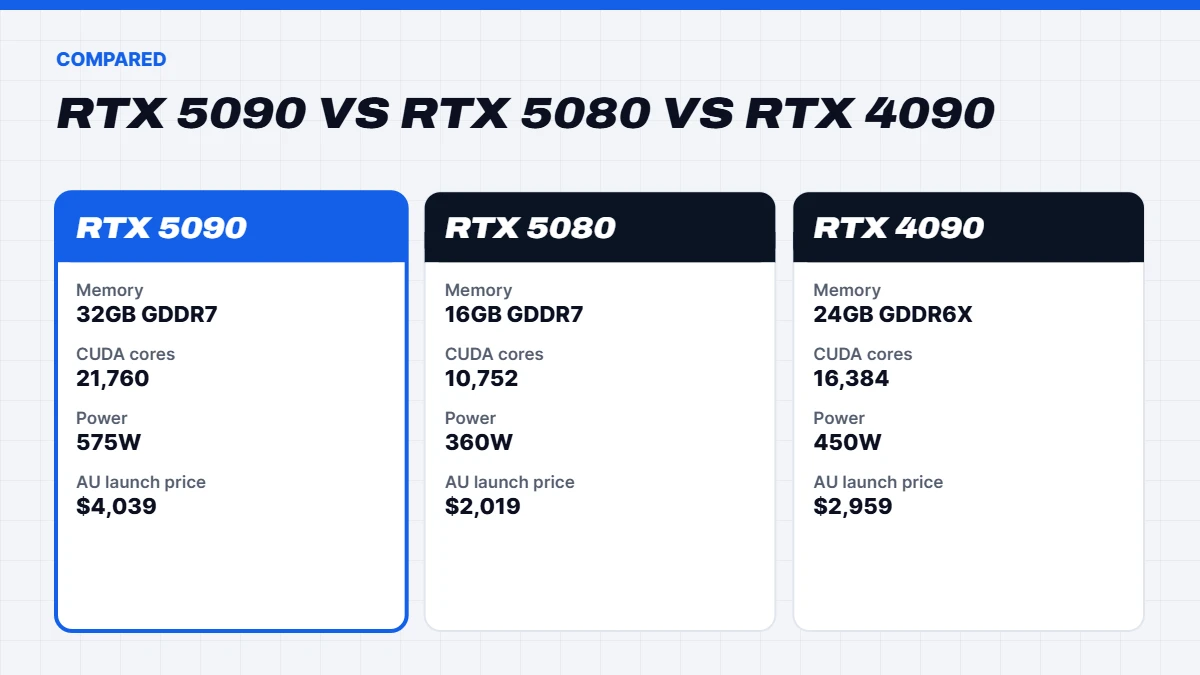
RTX 5090 vs RTX 5080 vs RTX 4090
| RTX 5090 | RTX 5080 | RTX 4090 | |
|---|---|---|---|
| Memory | 32GB GDDR7 | 16GB GDDR7 | 24GB GDDR6X |
| CUDA cores | 21,760 | 10,752 | 16,384 |
| Power | 575W | 360W | 450W |
| Australian launch price | $4,039 | $2,019 | $2,959 |
| DLSS 4 Multi Frame Generation | Yes | Yes | No |
| Best for | 4K high refresh, creators, AI | 4K and high-refresh 1440p | Still strong 4K card |
The RTX 4090 remains a very capable card, and if you already own one there’s little reason to upgrade unless you need the extra memory or Multi Frame Generation. The RTX 5080 is the sweet spot for most 4K gamers. Our guide to the RTX 5080 explains why.
Building around an RTX 5090
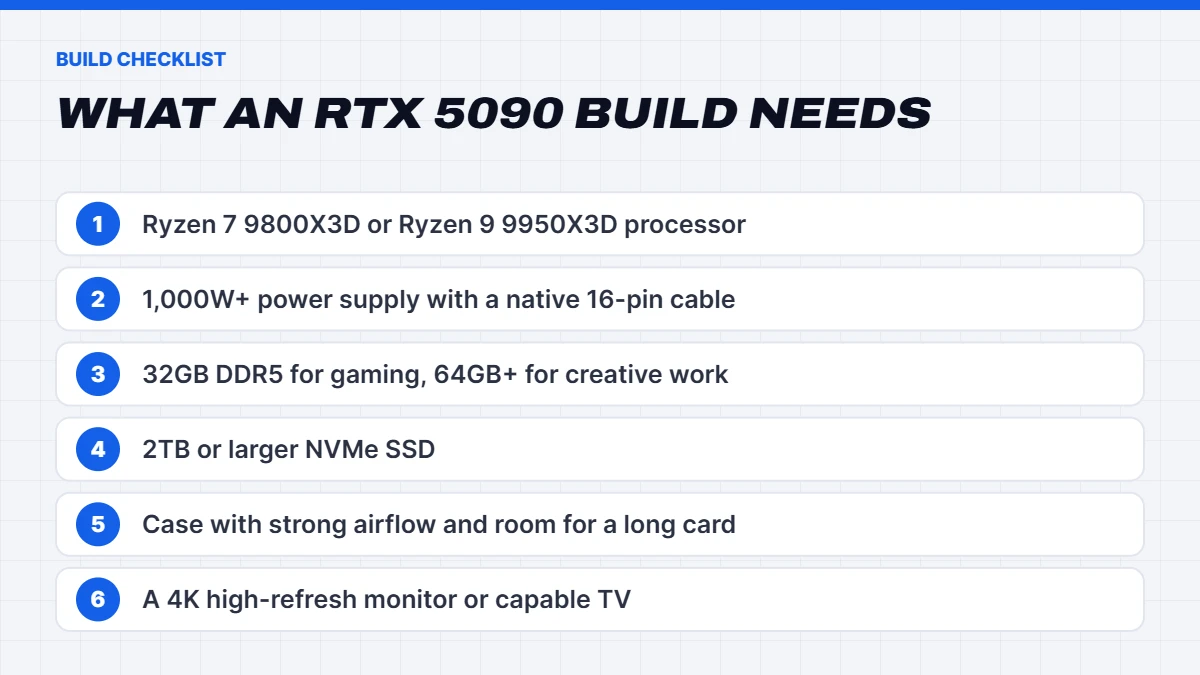
A card this fast needs the right partners, or you’ll leave performance on the table. Here’s what we pair it with:
- A top gaming processor. The Ryzen 7 9800X3D or Ryzen 9 9950X3D keeps the card fed in processor-heavy games. The 9950X3D adds more cores for rendering and streaming.
- A 1,000W or larger power supply from a reputable brand, with a native 16-pin cable.
- 32GB of DDR5 for gaming, 64GB or more for creative work. Large projects and AI models also use system memory.
- Fast NVMe storage. At least 2TB, because 4K game installs and project files are big.
- A case with strong airflow and room for a very long, thick card.
- A 4K high-refresh monitor or a capable TV. Anything less wastes the card.
Buying a card or a complete RTX 5090 PC
If you already have a high-end system with a strong power supply and a roomy case, buying the card alone can make sense, provided you can find one at a fair price with local warranty. If you’re starting fresh or your current PC would need a new power supply, case and processor anyway, a complete system is usually simpler and often better value right now.
Our extreme gaming PCs are built around the RTX 5090. The Best Value RTX 5090 Gaming PC pairs it with a Ryzen 7 9800X3D, the Vision TITAN X3D is our flagship 5090 PC with a Ryzen 9 9950X3D and 96GB of DDR5, and the Vision Phantom 5090 puts it all in a white build.
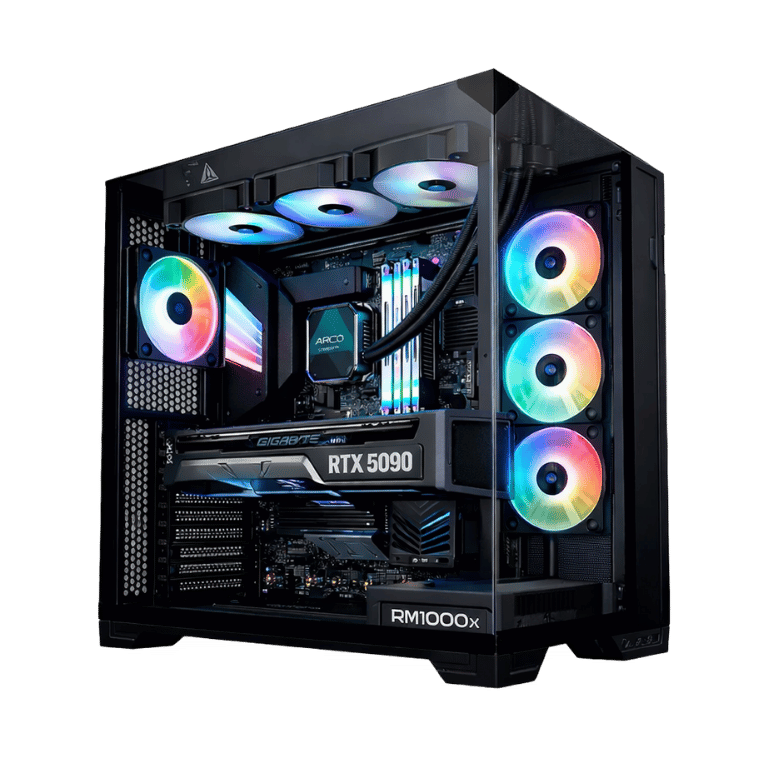
 Best Value RTX 5090 Gaming PC – Ryzen 7 9800X3D, 32GB DDR5 Original price was: $10,999.00.$8,249.00Current price is: $8,249.00.See the build
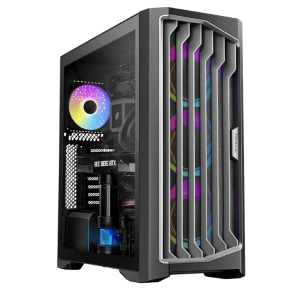 Vision TITAN X3D – 5090 PC, Ryzen 9 9950X3D, 96GB DDR5 Original price was: $13,000.00.$9,750.00Current price is: $9,750.00.See the build
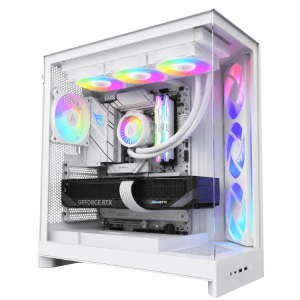 Vision Phantom 5090 – White RTX 5090 Gaming PC, 64GB DDR5 Original price was: $12,600.00.$9,450.00Current price is: $9,450.00.See the build
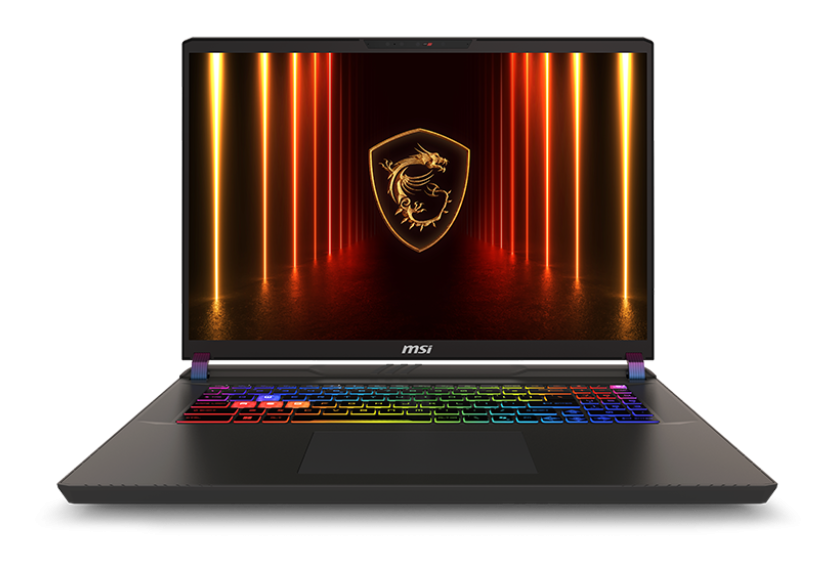
One naming trap to know about: the RTX 5090 laptop GPU isn’t the same chip. It’s a smaller design with 24GB of memory and performance closer to a desktop RTX 5080. It’s still the fastest laptop graphics you can get, as in the RTX 5090 laptop MSI Vector 17 HX AI, but don’t expect desktop RTX 5090 performance from it.
Is the RTX 5090 worth it in 2026?
If you’re in the group it’s built for, yes. Nothing else gives you this much performance and memory in one card, and nothing newer is on the horizon soon. NVIDIA’s rumoured RTX 50 Super refresh has been delayed by the memory shortage, and the next generation isn’t expected for a while.
For everyone else, the honest answer is no. It costs roughly twice as much as an RTX 5080 for a smaller gain in most games. Put the difference into a great monitor, a better processor or simply your savings, and you’ll enjoy your PC just as much.
RTX 5090 FAQs
How much is the RTX 5090 in Australia?
It launched at $4,039 for the Founders Edition in January 2025. In 2026, local prices have been well above that because of the memory shortage, and they change often. Check current listings and make sure the card has a local warranty.
How much VRAM does the RTX 5090 have?
32GB of GDDR7 on a 512-bit memory bus, the most of any GeForce card.
What power supply do I need for an RTX 5090?
NVIDIA recommends 1,000 watts for the whole system. Choose a quality unit with a native 16-pin 12V-2×6 cable.
Is the RTX 5090 worth upgrading to from an RTX 4090?
For most gamers, no. The RTX 4090 is still excellent. The upgrade makes more sense if you need 32GB of memory for creative or AI work, or want DLSS 4 Multi Frame Generation.
Can my current PC run an RTX 5090?
Check three things: a power supply of at least 1,000 watts with a proper 16-pin cable, a case with room for a very long and thick card, and a recent processor that won’t hold it back. If any of those is missing, the upgrade usually costs far more than the card alone.
Is there an RTX 5090 Super or Ti?
NVIDIA hasn’t announced one. Its rumoured RTX 50 Super refresh has been delayed by the memory shortage and wasn’t expected to include a faster RTX 5090.