
Why is RAM so expensive? If you’ve priced a memory upgrade or a new PC lately, you’ve probably had a shock. A 32GB DDR5 kit that was cheap and easy to find in 2024 can now cost several times as much, SSDs have jumped too, and the ripple effects reach graphics cards, laptops and complete PCs. It isn’t just you, and it isn’t just Australia.
This guide explains what’s going on in plain terms: why prices rose so fast, how long it might last, what it means if you’re buying a gaming PC, and how to get good value anyway, including why a 32GB RAM gaming PC is still the right target for most players.
Quick answer
RAM is expensive because of a global memory chip shortage that began in late 2025. AI data centres are buying enormous amounts of memory, and manufacturers have shifted production towards high-margin server and AI memory, leaving less for PCs. Prices for DDR5, DDR4 and SSDs rose sharply through 2026, and analysts expect tight supply to continue into 2027.
In this guide
Why is RAM so expensive right now?
Why is RAM so expensive now, when it was a bargain only a couple of years ago? It comes down to supply and demand, with one very hungry new customer.
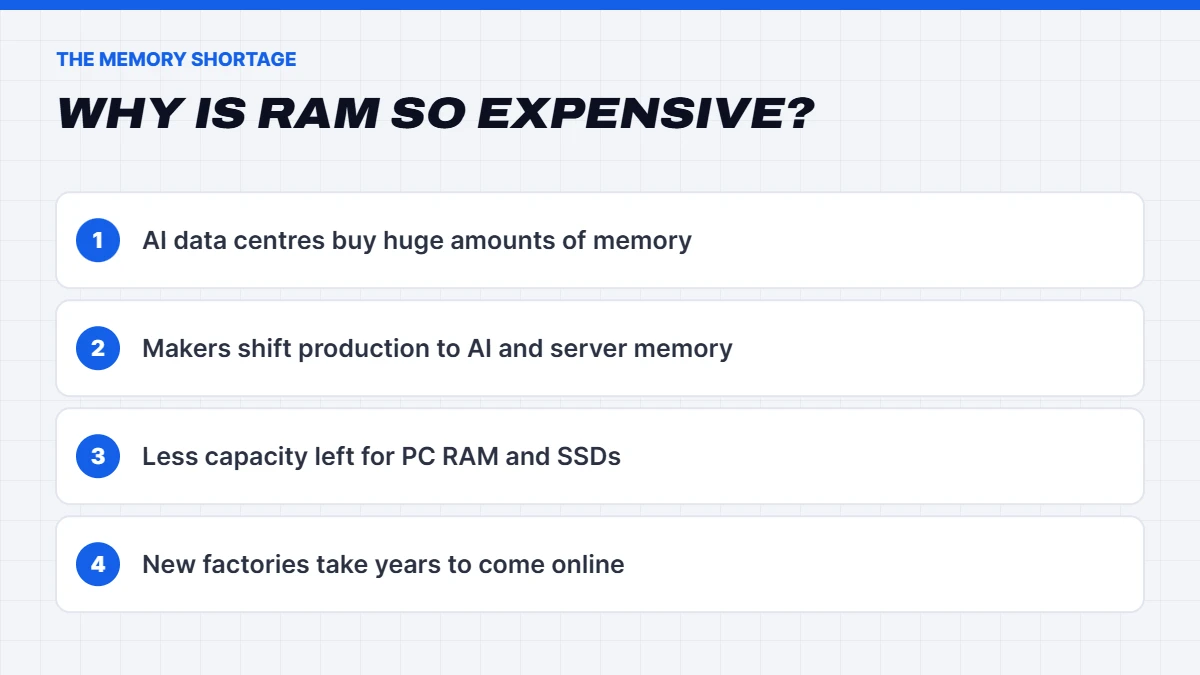
AI data centres need huge amounts of memory. Every AI server packs in large amounts of high-bandwidth memory, or HBM, alongside lots of regular server DDR5. As companies raced to build AI infrastructure through 2025 and 2026, demand for memory chips exploded.
Memory makers followed the money. Only a handful of companies produce most of the world’s DRAM. Building HBM and server memory is far more profitable than making consumer RAM sticks, so manufacturers shifted production capacity towards it. Every wafer used for AI memory is one that isn’t making PC RAM.
New factories take years. Memory fabs cost billions and take years to build and ramp up, so supply can’t respond quickly. When demand jumps suddenly, prices rise until it settles.
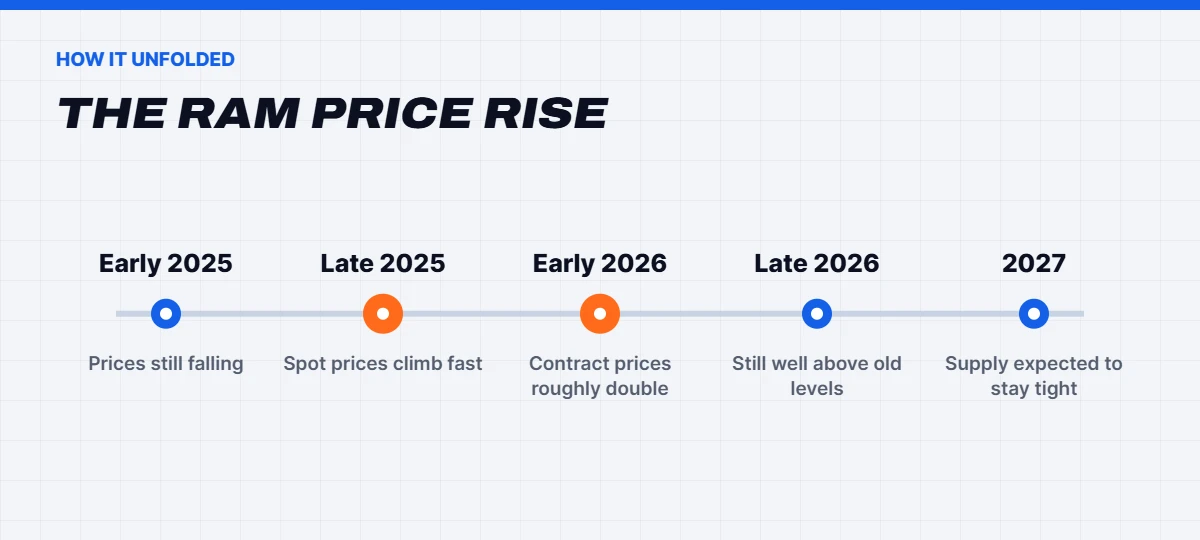
The result was one of the sharpest memory price rises on record. Industry analysts reported contract prices for PC DRAM roughly doubling in a single quarter in early 2026, and retail kit prices followed. PC Gamer’s coverage of why RAM and storage are so expensive tracks how far kit prices have climbed.
When did it start?
The rise began around the September quarter of 2025, after a long stretch of falling memory prices through 2024 and early 2025. By November 2025, spot prices for DDR5 chips were climbing week by week, and memory makers and PC builders began warning of price increases. Through the first half of 2026, prices kept rising, and by the second half of the year DDR5 and DDR4 kits were still well above their old levels.
One sign of how big the shift is: Micron, one of the world’s largest memory makers, announced it would wind down its Crucial consumer memory brand to focus on data centre customers. When a major manufacturer steps back from selling RAM to gamers, you know where the priorities lie.
It’s not just RAM
The same shortage affects anything with memory chips inside:
- SSDs use NAND flash, which has seen big price rises too, so storage costs more than it did.
- Graphics cards carry their own memory, so card prices have been pushed up, especially models with lots of VRAM. NVIDIA’s rumoured RTX 50 Super refresh, which would have added more memory, was reportedly delayed by the shortage.
- Laptops and prebuilt PCs have gone up as brands pass on higher memory costs, particularly for configurations with 32GB or more.
- Phones and consoles feel it too.
That’s why the question of why is RAM so expensive is really a question about the whole PC market in 2026.
How long will RAM prices stay high?
Nobody can say for certain. Many analysts expect supply to stay tight into 2027, because AI demand shows no sign of slowing and new production capacity takes time to come online. Prices may ease gradually as new fabs open and demand settles, but a quick return to 2024 prices looks unlikely.
Our honest advice: don’t wait indefinitely. If you need a PC now, buy what you need now, with the right amount of RAM from the start. If your current PC is fine, there’s no rush, and you can keep an eye on prices.
Why is it so hard to make more memory?
Memory chips are made in some of the most complex factories on earth. A modern DRAM fab costs many billions of dollars, takes years to build, and needs specialised equipment that’s itself in short supply. Only a few companies, mainly Samsung, SK Hynix and Micron, make the vast majority of the world’s DRAM, so there’s no quick way for a new player to fill the gap.
High-bandwidth memory for AI makes things harder still. HBM stacks many layers of memory chips together and uses more wafer area per gigabyte than ordinary DRAM. So when manufacturers make more HBM, total gigabytes produced can actually fall, even if the factories are running flat out. That’s a big part of why consumer memory got squeezed so hard.
Why is RAM so expensive in Australia?
Australian buyers have felt the price rises at least as sharply as anyone. Memory is priced globally in US dollars, so movements in the exchange rate flow straight through to local prices. Freight, GST and the smaller size of the Australian market add to it, and when stock is short, smaller markets often get smaller allocations. The result is that local RAM and SSD prices rose quickly through late 2025 and 2026, and stock of popular kits has come and gone.
The same factors affect graphics cards and laptops sold here, which is why local prices for many PC parts have run well above their original launch prices this year.
What the shortage means for laptops
Laptops are hit in a particular way. Most thin laptops have soldered memory, so the amount you choose at purchase is permanent. With memory more expensive, some brands have charged a lot more for higher-memory configurations, and some cheaper models have shipped with only 8GB to keep prices down. Our advice hasn’t changed: buy a Windows laptop with at least 16GB, even if it costs a little more, because you can’t add it later. Our laptops list the RAM clearly in every model.
Should you wait or buy now?
So, knowing why is RAM so expensive now, should you hold off? It’s tempting to wait it out, but the honest answer depends on your situation. If your current PC still runs well, waiting costs you nothing, and prices may ease over time. If your computer is failing, too slow for your work, or you’ve been putting off a new gaming PC for a while, waiting another year for prices that may or may not fall is a long time to go without.
What we’d avoid is the worst of both: buying a cheaper PC with too little RAM to save money now, then paying today’s high prices for an upgrade in six months. Whatever you decide on timing, get the right amount up front.
Is used RAM worth it?
Second-hand RAM can be a decent way to save, especially DDR4 for older systems, but there are risks. You won’t know how it was treated, it may not match your existing sticks, and you usually lose any warranty. If you go this way, buy a matched kit from a seller who lets you return it, and test it with Windows Memory Diagnostic or a similar tool straight away.
Spotting a genuinely good deal during a shortage
When prices rise fast, it’s harder to tell what’s a fair price. A few tips:
- Compare against this year’s prices, not 2024’s. A “deal” that’s still well above old prices might be good value today.
- Look at the cost per gigabyte when comparing kits of different sizes.
- Check the whole system. A PC with 32GB and a 2TB SSD carries much more memory value than one with 16GB and 512GB, even at a similar price.
- Be wary of prices far below everyone else. During shortages, scam listings increase.
Getting the most from the RAM you already have
Before spending anything, it’s worth checking that your current memory is working as well as it can. Open Task Manager, go to Performance, then Memory, and look at the speed and the number of slots used. If the speed is far below what your kit is rated for, turn on XMP or EXPO in the BIOS, which is free and often makes a noticeable difference. If you see one slot used out of two or four, a matching second stick will give you dual channel.
Closing background apps you don’t need, like extra launchers or browser tabs left open for days, also frees up memory during games. None of this replaces having enough RAM, but it can stretch an older PC a little further while prices are high.
What it means for buying a gaming PC
The shortage changes a few of the usual rules of thumb:
Buy the right amount up front. If you’re shopping for a 32GB RAM gaming PC, buy it with 32GB rather than planning to upgrade. Adding RAM later used to be the cheap upgrade. In 2026 it’s often the expensive one. Choosing a PC with 32GB now usually costs less than buying 16GB and upgrading later.
Price the whole system, not the parts. Memory now makes up a bigger share of a PC’s cost. When comparing builds, look at the total price for the same RAM amount, SSD size and graphics card, rather than chasing a headline discount.
Check for dual channel. Some cheap builds save money with a single stick of RAM. Two matched sticks run faster, so make sure you’re getting a proper kit.
Don’t overbuy either. 64GB or 128GB is great for creative and AI work, but for gaming, 32GB is plenty. The money saved on extra RAM is better spent on the graphics card.
Why a 32GB RAM gaming PC is still the sweet spot
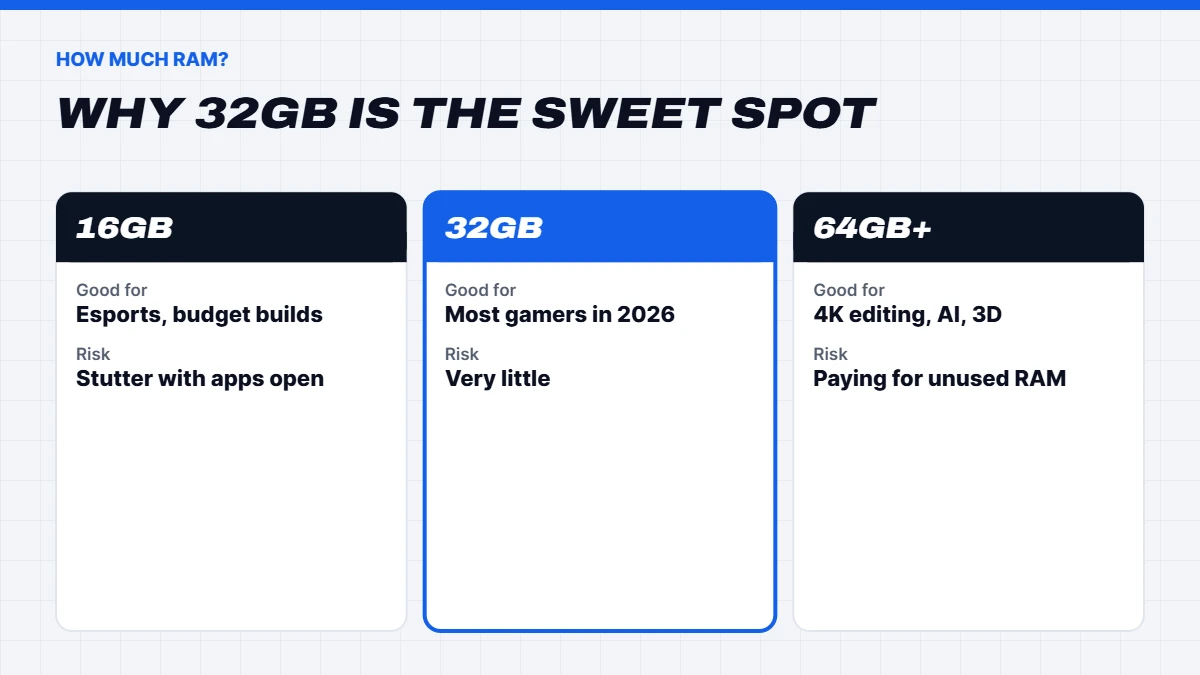
Even with high prices, a 32GB RAM gaming PC is still the right choice for most players in 2026. New big-budget games increasingly recommend 32GB, and with Discord, a browser and a launcher running alongside, 16GB fills up fast and causes stutter in busy scenes. 32GB gives you headroom for the next few years without paying for memory you won’t use.
16GB still works for budget builds focused on esports titles, and 64GB makes sense if you edit 4K video, stream at a high level or run AI tools. But for the typical gamer, 32GB in two sticks is where we’d put the money. Our guide to what RAM is and how much you need goes into more detail on choosing the right amount.
DDR4 vs DDR5 in a shortage
DDR4 hasn’t escaped the price rises, but it’s often still cheaper than DDR5. If you have an older AMD AM4 or Intel 12th to 14th-gen system with DDR4, upgrading within DDR4 can make sense. For a brand-new gaming PC, though, the current platforms need DDR5, and the performance and upgrade path are worth it. Our DDR4 vs DDR5 guide explains the trade-offs in more detail.
Tips for getting good value anyway
- Decide your RAM amount first, based on what you do, then compare PCs with that amount.
- Compare complete systems. A prebuilt priced as a whole can be simpler than sourcing every part at today’s prices.
- Watch for single-stick builds and avoid them.
- Don’t pay extra for very fast RAM. DDR5-6000 is plenty for gaming.
- Keep your old PC running a bit longer if it still does what you need. A clean-up and an SSD check can buy you time.
Our 32GB RAM gaming PCs
Most of our mid-range and high-end gaming PCs come with 32GB of DDR5 in two sticks, so they run in dual channel. Each of these is a 32GB RAM gaming PC built for current games:
- The Vision Vector, a 7800X3D PC with an RTX 5070 and 32GB of DDR5.
- The Best Value RTX 5080 Gaming PC, an RTX 5080 gaming PC with a Ryzen 7 7800X3D and 32GB of DDR5.
- The Vision Performance RGB, an RGB PC with an RTX 5070.
If you need more memory for creative work, our 64GB RAM PC and workstation PCs go further.
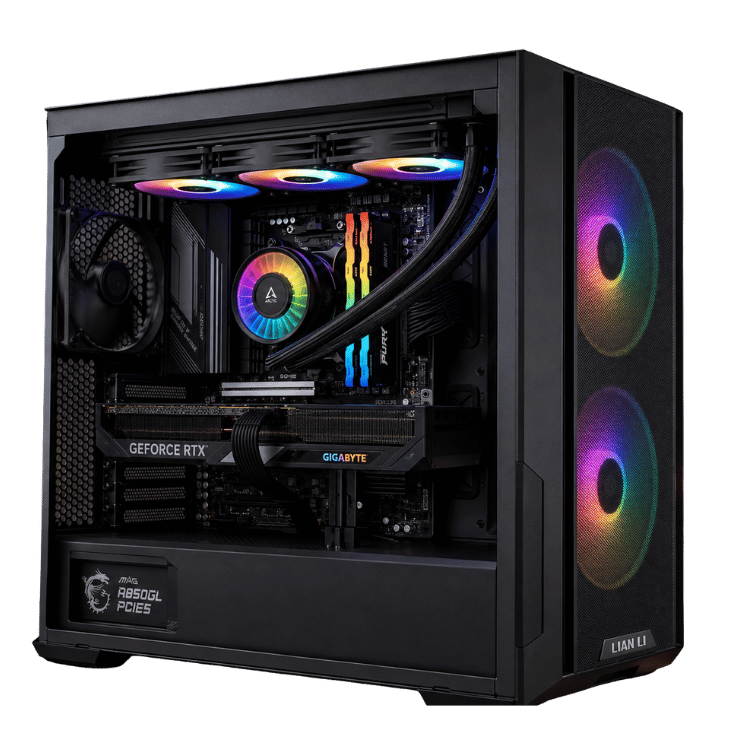
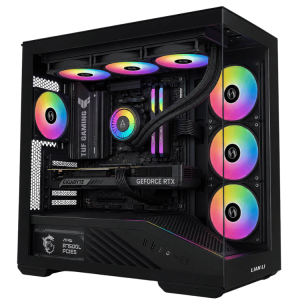 Vision Vector – 7800X3D PC with RTX 5070, 32GB DDR5 Original price was: $4,399.00.$3,299.00Current price is: $3,299.00.See the build
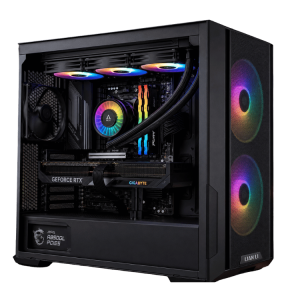 Best Value RTX 5080 Gaming PC – Ryzen 7 7800X3D, 32GB DDR5 Original price was: $5,999.00.$4,499.00Current price is: $4,499.00.See the build
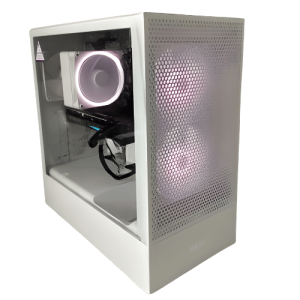 Vision Performance RGB – RGB PC with RTX 5070 & Ryzen 7 7800X3D Original price was: $3,600.00.$2,700.00Current price is: $2,700.00.See the build
The short version
Why is RAM so expensive now? AI data centres are buying memory faster than the world can make it, manufacturers are prioritising those customers, and new factories take years. Prices for RAM, SSDs and anything containing memory rose sharply from late 2025 and stayed high through 2026.
For buyers, the practical steps are simple. Decide how much memory you really need, buy it up front, compare complete systems on total value, and don’t panic-buy more than you need. For most players, a 32GB RAM gaming PC with a graphics card matched to their screen is still the best balance of price and performance.
RAM price FAQs
Why is RAM so expensive in 2026?
Because of a global memory chip shortage driven by AI data centres, which buy huge amounts of memory and have pulled manufacturing capacity away from consumer RAM.
Why is RAM so expensive now compared with 2024?
In 2024 there was a memory surplus and prices were low. From late 2025, AI demand surged and supply couldn’t keep up, so prices rose sharply.
Will RAM prices go down?
Probably eventually, as new factories come online, but many analysts expect tight supply into 2027.
Is a 32GB RAM gaming PC worth it?
Yes. 32GB is the sweet spot for gaming in 2026, giving headroom for new games and background apps.
Why is RAM so expensive in Australia compared with overseas?
Exchange rates, freight, GST and smaller stock allocations to the Australian market all add to the global price rise.
Why is RAM so expensive for gaming PCs in particular?
Gaming PCs use more memory than basic computers, typically 32GB of RAM plus a graphics card with its own memory and a large SSD, so the shortage adds more to their cost.
What’s a fair price for a 32GB RAM gaming PC?
It depends on the graphics card and processor. Compare systems with the same RAM, SSD and graphics card, and judge them against this year’s prices rather than 2024’s.
Should I buy DDR4 to save money?
Only if you’re upgrading an existing DDR4 system. New gaming platforms need DDR5.