The RTX 5070 Ti is the card we’d pick for most serious 1440p gamers, and it’s the one that makes entry-level 4K genuinely enjoyable. It has the same 16GB of GDDR7 memory and 256-bit bus as the RTX 5080, a little less muscle, and a much friendlier price. Its main rival is AMD’s Radeon RX 9070 XT, another 16GB card that often costs less.
So which should you buy? This guide covers the specs, Australian pricing, what each card does best, and an honest 9070 XT vs 5070 Ti comparison across performance, features, power and value. Spoiler: both are excellent, and the right one depends on the games you play.
Quick answer
The GeForce RTX 5070 Ti has 8,960 CUDA cores and 16GB of GDDR7, and it launched in Australia at $1,509. The Radeon RX 9070 XT has 16GB of GDDR6 and launched for less. In traditional rendering they’re close. The RTX 5070 Ti wins on ray tracing, path tracing and DLSS 4. The RX 9070 XT usually wins on price. For heavy ray tracing, choose NVIDIA. For the most frames per dollar, choose AMD.
In this guide
What is the RTX 5070 Ti?
The RTX 5070 Ti is the upper-mid card in NVIDIA’s GeForce RTX 50 series, built on the Blackwell architecture. It launched on 20 February 2025, replacing the RTX 4070 Ti Super. Unlike the RTX 5090, 5080 and 5070, NVIDIA didn’t make its own Founders Edition version, so every card comes from partners like ASUS, MSI and Gigabyte.
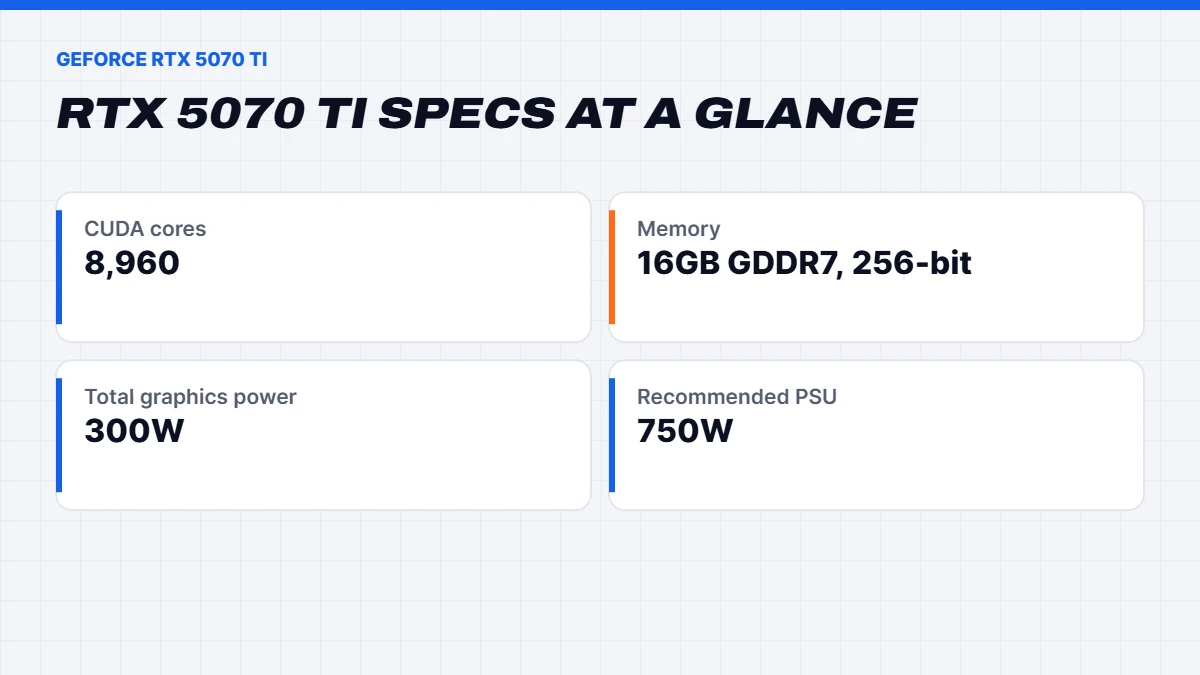
It shares its GB203 chip with the RTX 5080, with some cores switched off. That gives it 8,960 CUDA cores, 16GB of GDDR7 memory and the same 256-bit memory bus as the bigger card. The generous memory is the reason it ages so well: textures that would squeeze a 12GB card fit comfortably.
RTX 5070 Ti specs
| Spec | RTX 5070 | RTX 5070 Ti | RTX 5080 |
|---|---|---|---|
| CUDA cores | 6,144 | 8,960 | 10,752 |
| Memory | 12GB GDDR7 | 16GB GDDR7 | 16GB GDDR7 |
| Memory interface | 192-bit | 256-bit | 256-bit |
| Total graphics power | 250W | 300W | 360W |
| Recommended system power | 650W | 750W | 850W |
| Australian launch price | $1,109 | $1,509 | $2,019 |
NVIDIA’s full specifications are on its GeForce RTX 50 Series page.
Price in Australia
The RTX 5070 Ti launched in Australia at $1,509, with most partner cards priced a little above that. AMD’s RX 9070 XT launched at US$599 against the 5070 Ti’s US$749, and that gap carried through to Australian shelves, where the Radeon has generally been the cheaper card.
In 2026, the global memory shortage has pushed graphics card prices up across the board, and both cards have spent much of the year above their launch prices. Stock comes and goes. If you’re buying a card on its own, compare prices on the day and check the warranty is local. If you’re buying a whole PC, the card’s price is folded into the system, which often works out better.
What is the RTX 5070 Ti good at?
We don’t quote frame rates we haven’t measured ourselves, because they change with every driver and patch. What reviews agree on is the card’s place in the line-up. It’s a clear step up from the RTX 5070, roughly a fifth faster in most games, and it sits a little behind the RTX 5080. In traditional rendering it lands close to the old RTX 4080.
That makes it a superb 1440p card, including at 240Hz, and a capable 4K card with DLSS switched on. Its 16GB of memory means high-resolution texture packs and demanding new releases don’t trip it up, which is a big part of why we steer long-term buyers towards it.
9070 XT vs 5070 Ti: the head-to-head
This is the comparison most buyers care about, so let’s go through it properly.
Traditional performance
In games without ray tracing, the two cards are close. Some reviews give the RX 9070 XT a small edge, others the RTX 5070 Ti, and the result changes from game to game. For practical purposes, call it a draw. Both handle 1440p at high refresh rates and 4K with upscaling.
Ray tracing and path tracing
This is where NVIDIA pulls ahead. AMD’s RDNA 4 architecture improved ray tracing a lot compared with its previous cards, but the RTX 5070 Ti is still clearly faster with heavy ray tracing, and the gap grows with full path tracing. If you love games like Cyberpunk 2077, Alan Wake 2 or Indiana Jones and the Great Circle with all the lighting effects on, NVIDIA is the better card.
Upscaling and frame generation
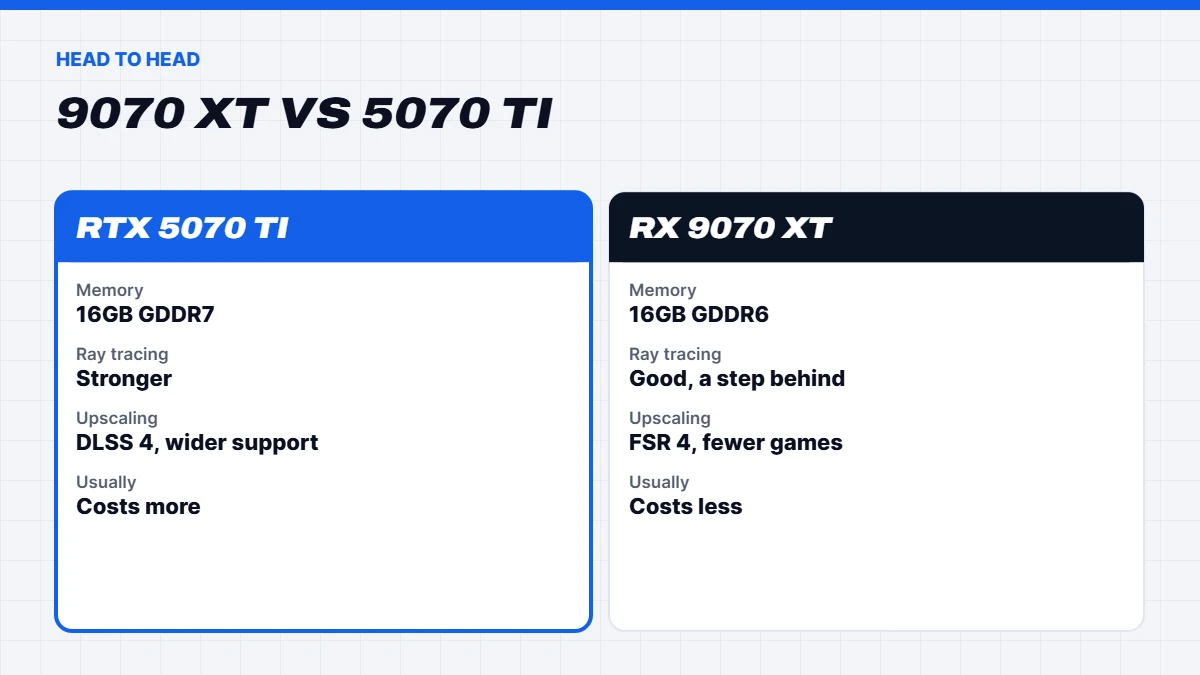
NVIDIA’s DLSS 4 is supported in a very large number of games, and its Multi Frame Generation is exclusive to RTX 50 cards. AMD’s FSR 4 is a big leap over earlier versions and looks very good, but it’s available in fewer games. If you rely on upscaling, DLSS still has the edge in support.
Memory
Both have 16GB. The RTX 5070 Ti uses faster GDDR7, while the RX 9070 XT uses GDDR6 backed by a large on-chip cache. In practice, neither runs short of memory at 1440p or 4K in today’s games.
Power
They draw similar power, about 300 watts each, and both are happy with a quality 750-watt power supply in a typical build.
Value
The RX 9070 XT usually costs less, which makes it the value winner in traditional games. The RTX 5070 Ti costs more but gives you better ray tracing and wider DLSS support for the money.
Which one should you buy?
Here’s how we’d decide between the two:
- Choose the RTX 5070 Ti if you play lots of ray-traced single-player games, want DLSS 4 Multi Frame Generation, stream with NVIDIA’s encoder, or use creative apps that favour NVIDIA.
- Choose the RX 9070 XT if you mostly play esports and traditional games, want the most performance per dollar, or simply prefer AMD.
Either way, you’re getting a card that will handle 1440p beautifully for years. The 5070 Ti vs 9070 XT choice is about priorities, not about one being bad.
If you’re weighing up the cheaper RTX 5070 instead, our RTX 5070 guide explains where 12GB of memory is enough and where it isn’t. If you’re leaning towards AMD, our RX 9070 XT guide covers it in depth.
Is it worth it over the RTX 5080?
For 1440p, yes. The RTX 5070 Ti gets you most of the way to the RTX 5080 at 1440p for considerably less, with the same 16GB of memory. At 4K, the RTX 5080’s extra power becomes more noticeable, so if 4K is your main resolution, it’s worth stretching. Our RTX 5080 guide covers that decision in detail.
Games where each card shines
The differences between the two cards show up most clearly in specific kinds of games.
Competitive and esports titles. Valorant, Counter-Strike 2, Fortnite in performance mode, Apex Legends and Marvel Rivals run brilliantly on both. Frame rates are high enough that either card will max out most 240Hz monitors at 1440p. AMD’s lower price makes it the value pick here.
Big single-player games with ray tracing. This is NVIDIA’s home ground. Path-traced lighting, ray-traced reflections and DLSS 4 frame generation make these games look and feel their best on the GeForce card.
Open-world and survival games. Games with huge draw distances and lots of textures appreciate 16GB of memory, which both cards have. Performance is close, so choose on price and features.
Simulators. Racing and flight sims often lean on the processor as much as the graphics card. Pair either card with an X3D processor for the smoothest results, and consider VR performance if you use a headset. NVIDIA has historically had wider support in VR titles.
Noise, heat and size
Both cards draw around 300 watts and most partner models use large triple-fan coolers, so they stay reasonably quiet in a well-ventilated case. Card sizes vary a lot between brands, from fairly compact dual-slot designs to thick triple-slot coolers, so check the length against your case. If quiet operation matters most, look for a model with a bigger cooler and set a gentle fan curve, and make sure your case has plenty of front intake.
Which monitor suits it?
To get the most from either card, pair it with a 27-inch 1440p monitor at 165Hz to 240Hz, or an entry-level 4K monitor at 144Hz if you’re happy to use upscaling. An OLED panel brings out the best in ray-traced games thanks to its perfect blacks. A 1080p screen leaves a lot of the card’s ability unused. Our guide to Black Friday monitor deals explains how to match resolution and refresh rate to your card.
Upgrading from an older card
From an RTX 2070, RTX 3060 Ti or RX 6600 XT, the jump is enormous: higher settings, higher resolution and modern upscaling your old card can’t use. From an RTX 3080 or RX 6800 XT, it’s a meaningful upgrade with much better ray tracing and 16GB of memory. From an RTX 4070 Ti Super or RX 7900 XT, the gain is modest, and we’d only upgrade if you want DLSS 4 Multi Frame Generation or need a specific feature.
Check your power supply before upgrading. A quality 750-watt unit is the target, and an older 650-watt unit may struggle under load. If your processor is several generations old, a complete new PC often makes more sense than a card swap.
Drivers and software
Both companies’ software is mature and stable these days. NVIDIA’s App handles drivers, game optimisation, recording and its overlay in one place. AMD’s Adrenalin software does the same and includes handy extras like built-in performance tuning and AMD’s frame generation for games that don’t support FSR 4 natively. Neither is a reason to choose one card over the other on its own.
Building a PC around the RTX 5070 Ti
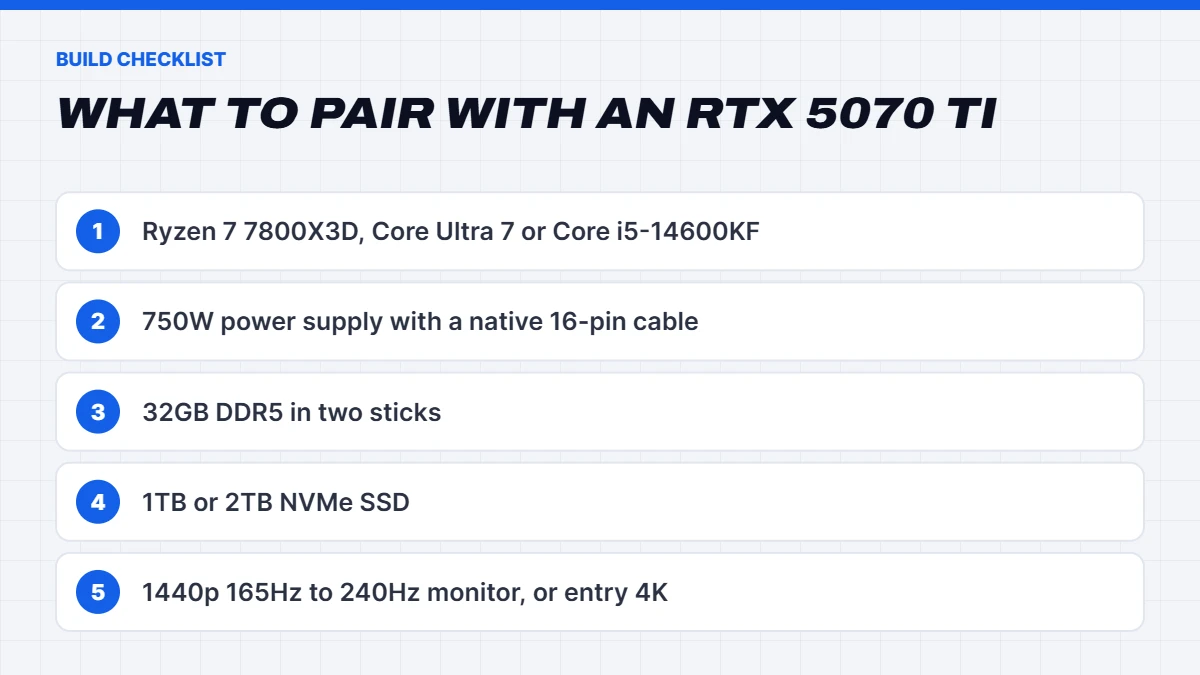
- A strong gaming processor. The Ryzen 7 7800X3D is our favourite partner. An Intel Core Ultra 7 or Core i5-14600KF also works well, especially if you do some productivity work too.
- A 750-watt power supply from a reputable brand, with a native 16-pin cable.
- 32GB of DDR5 in two sticks.
- A 1TB or 2TB NVMe SSD.
- A 1440p monitor at 165Hz to 240Hz, or an entry-level 4K screen.
Our RTX 5070 Ti and RX 9070 XT PCs
We build with both cards, so you can choose either side. On the NVIDIA side, the Extreme Mid Tier is a 5070 Ti PC with an Intel Core i5-14600KF, the Vision Vortex 5070 Ti is an Intel gaming PC with a Core Ultra 7 265KF, the Vision Red Fury is a striking red gaming PC, and the Vision Absolute Zero puts the card in a white RTX 5070 Ti gaming PC.
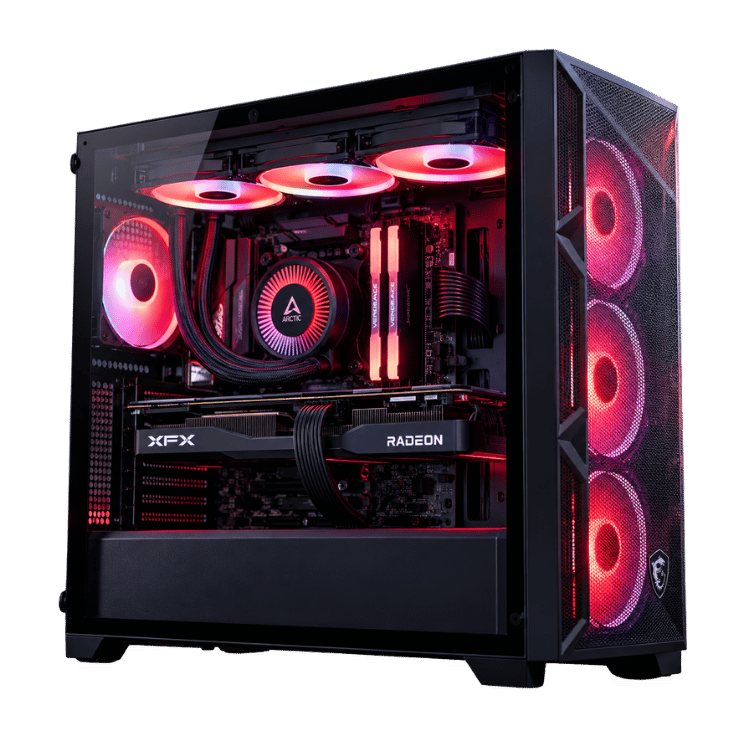
On the AMD side, the Vision Phantom XT is a 9070 XT PC with a Ryzen 7 7800X3D, and the Vision Phantom X3D is a 9070 XT prebuilt with the Ryzen 7 9800X3D.
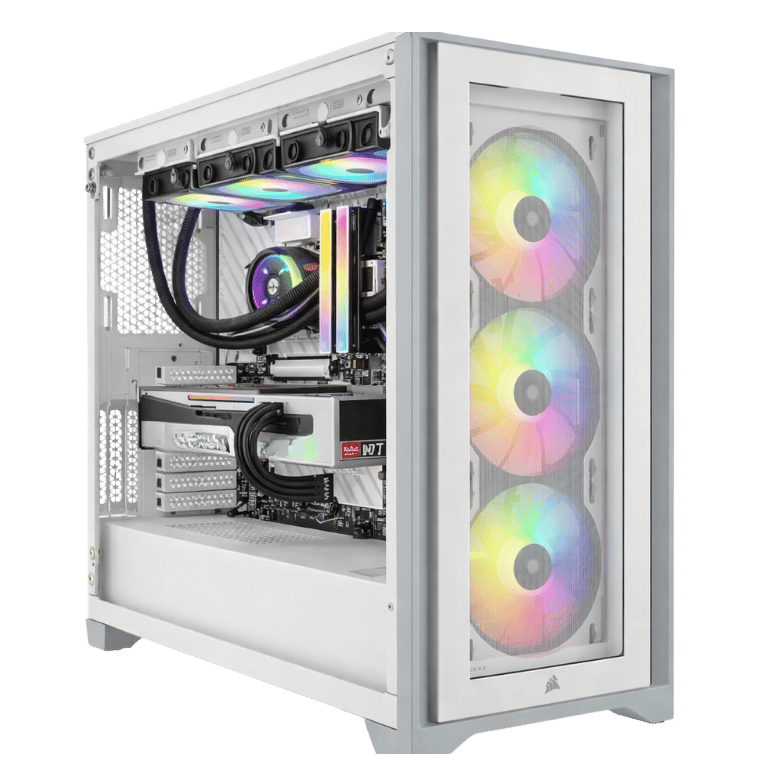
 Extreme Mid Tier – RTX 5070 Ti PC, Intel Core i5-14600KF Original price was: $4,999.00.$3,749.00Current price is: $3,749.00.See the build
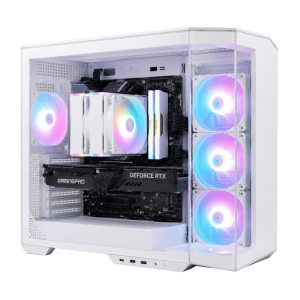 Vision Vortex 5070 Ti – Intel Gaming PC, Core Ultra 7 265KF Original price was: $4,450.00.$3,337.00Current price is: $3,337.00.See the build
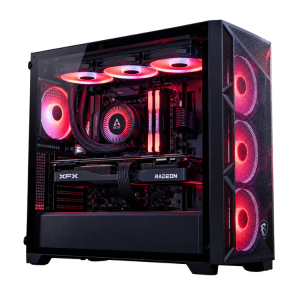 Vision Phantom XT – 9070 XT PC, Ryzen 7 7800X3D Original price was: $4,100.00.$3,075.00Current price is: $3,075.00.See the build
Streaming and creative work
If you stream, NVIDIA’s encoder is the safer choice, with excellent quality and wide support in OBS, Discord and other apps. AMD’s encoder has improved a lot in recent generations and is perfectly usable, but NVIDIA still leads on quality at low bitrates.
For creative apps, NVIDIA’s CUDA support gives it an edge in Blender, many AI tools and some video plug-ins. If creative work matters to you, that tips the balance towards the RTX 5070 Ti. For video editing in DaVinci Resolve, both cards do well.
How future-proof is it?
No graphics card is truly future-proof, but this one is about as close as it gets at its price. The 16GB of memory is the key. Game sizes and texture budgets keep growing, and 16GB gives plenty of room for the next few years at 1440p and for most games at 4K with upscaling. DLSS 4 will also keep improving through driver updates, and newer image models have already made upscaled images sharper on existing cards.
There’s also the bigger picture. NVIDIA’s next generation isn’t expected for a while, and the rumoured Super refresh has been delayed by the memory shortage. That means today’s RTX 50 cards will be the current models for some time, which is good news for driver support and game optimisation. If you buy one now, expect four or more years of comfortable 1440p gaming before it starts to feel its age.
Who should buy the RTX 5070 Ti?
It’s the right card if you game at 1440p on a fast monitor, want to dip into 4K, love ray tracing, or want 16GB of memory for the long haul without paying RTX 5080 prices. It’s more card than you need for 1080p, and if you’re on a tight budget, the RTX 5070 or RX 9070 gets you to 1440p for less.
RTX 5070 Ti FAQs
How much VRAM does the RTX 5070 Ti have?
16GB of GDDR7 on a 256-bit bus, the same amount as the RTX 5080.
Is the RX 9070 XT better than the RTX 5070 Ti?
In traditional rendering they’re very close, and the RX 9070 XT often costs less. The RTX 5070 Ti is better at ray tracing and has wider DLSS support.
Is the RTX 5070 Ti good for 4K?
Yes, especially with DLSS. For 4K at high refresh rates in the heaviest games, the RTX 5080 has more headroom.
What power supply do I need?
NVIDIA recommends 750 watts for a system with the RTX 5070 Ti. The RX 9070 XT has similar needs.
Which is better for streaming, 5070 Ti vs 9070 XT?
NVIDIA’s encoder is still the safer choice for streaming, with excellent quality at low bitrates and wide app support. AMD’s encoder is good and improving, but NVIDIA keeps the edge.
Will it run new games at 1440p for years?
Yes. With 16GB of memory and DLSS 4, it’s well placed to handle new releases at 1440p for several years, with settings adjusted for the very heaviest games.
Is there an RTX 5070 Ti Super?
NVIDIA hasn’t released one. A 24GB RTX 5070 Ti Super was widely rumoured, but reports say the RTX 50 Super refresh was delayed by the 2026 memory shortage.